Top 7 Annotation Tools for Semantic Segmentation in 2025
 By Anolytics | 19 September, 2025 in Data Annotation | 5 mins read

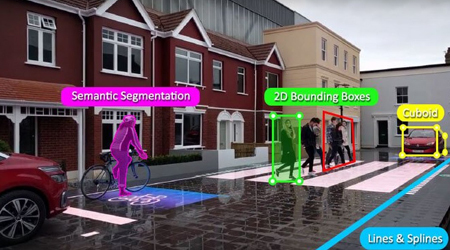
Semantic segmentation is an advanced image annotation method in computer vision. It assigns a class label to every pixel in an image, enabling AI models to understand objects, their boundaries, and their context at the most detailed level. For example, in autonomous vehicle projects, semantic segmentation is applied to categorize roads, lanes, pedestrians, and vehicles, while in medical imaging, it helps segment tumors, organs, and tissues.
At Anolytics, we facilitate the increased need for precise image labeling across several sectors, driven by developments in artificial intelligence and machine learning. Pushing this momentum forward, we aim to utilize both human accuracy and AI to quickly create and label data for text, images, audio, and video.
In creating semantic segmentation training data, we rely on various tools depending on the project’s needs. In this blog, we explore the benefits and key features of the semantic segmentation tools we use that will get any AI model ready for production.
7 Impressive Semantic Segmentation Annotation Tools in The Market
The following is a comparison of the top data annotation service providers and tools in the domain of image segmentation.
1. V7 Labs
Data annotation is where V7 Labs really shines; the company was founded with the express purpose of enhancing machine vision operations. Many projects at Anolytics have been annotated using this tool because of its scalability, accuracy, and speed, which allow teams to easily tackle complicated tasks like semantic segmentation. V7 Labs makes annotation easy and suitable for production with its AI-powered features, collaborative tools, and automation.
Key features:
- Its AI-powered automated capabilities make it stand out since they make the annotating process easier. V7 Labs has tools for making thorough segmentations and works with many different types of data.
- The platform has built-in version control and project management tools that let several people work on the same project at the same time.
- V7 Labs interfaces with well-known machine learning frameworks, so customers may add AI models to their annotation processes.
- Also, the platform puts a lot of emphasis on data security. It uses strong encryption and follows industry standards, which makes it a good choice for organizations and research teams.
2. CVAT (Computer Vision Annotation Tool)
CVAT (Computer Vision Annotation Tool) is a free online tool developed by Intel/OpenCV that provides a wide range of annotation features, including polygons, points, and cuboids. It also offers semi-automatic labeling using models such as SAM, YOLOv3, and DEXTR, along with tools for managing projects and access.
Key Features:
- It can handle different data types and complexity well enough to annotate videos and images, including polygons, bounding boxes in two dimensions, and semantic segmentation.
- The description of annotation features includes advanced methods like interpolation and frame-wise changes for video annotations.
- Its AI-assistance function includes semi-automatic annotation capabilities, which makes processes more efficient.
- To ensure scalability, it encompasses the capacity to easily manage large-scale projects suited for both individual and business use.
- The collaboration of the semantic segmentation annotation tool simplifies team-based labeling and offers options for managing role-based access control.
3. Amazon SageMaker Ground Truth
Another option for semantic segmentation tasks is Amazon SageMaker Ground Truth, which integrates well with Amazon Web Services (AWS). It has built-in active learning capabilities and offers a comprehensive set of model customization capabilities, while streamlining the annotation process.
Key Features:
- Supports image, video, text, and audio labeling for machine learning applications, including categorization, object identification, and semantic segmentation. The complexity of the data type is also supported.
- The annotation features include active learning procedures, allowing machine learning models to label data alongside human evaluation.
- The complete integration of machine learning pipelines, including Amazon SageMaker and other Amazon Web Services services, simplifies processes.
- The system is highly scalable and has the capacity to effectively manage large datasets.
- The collaboration feature allows for user management and role-based access restriction, supporting team collaboration.
4. Roboflow
Roboflow is an open-source platform for creating complex vision AI pipelines using custom models, open-source models, LLM APIs, and external applications.
Key Features:
- Specializes in images and videos for object identification, segmentation, and classification activities.
- Includes auto-annotation features that make use of artificial intelligence to expedite the process and decrease the amount of manual insertion.
- Offers smooth integration with TensorFlow, PyTorch, and other popular frameworks.
Designed to handle both small and large datasets using cloud-based infrastructure. Thus, scalability is optimized for managing both.
5. Ilastik
It is an open-source annotation tool designed for image segmentation while focusing on bioimaging applications. Its intuitive interface allows non-experts to perform complex image analysis tasks while still offering advanced functionality for researchers.
Key Features
- Specializes in bioimaging data and also supports various scientific image analysis tasks.
- Offers pixel classification, object classification, and image segmentation while minimizing manual dependency.
- It has pre-trained machine learning models to simplify annotation.
- Can be integrated with Python for scripting and workflow automation, with outputs exportable to popular ML frameworks.
6. TagLab
It is an open-source annotation tool designed for the semantic segmentation of large-scale images. With emphasis on ecological and environmental research, it was initially developed to study coral reefs and orthoimages. It provides precise and efficient annotations by integrating domain-focused usability with CNN-based AI assistance.
Key Features:
- Optimized for very large images, such as orthoimages and ecological datasets (e.g., coral reef mapping).
- Provides polygonal and semantic segmentation annotation tools tailored for environmental datasets.
- Integrates CNN-based models to support automated segmentation, reducing manual effort while improving accuracy.
- Exports data in widely used formats for compatibility with deep learning workflows.
- Built to process high-resolution, large-scale imagery without performance bottlenecks. It is community-driven, focusing on supporting researchers and conservationists, making it ideal for collaborative scientific projects.
7. EISeg
EISeg is also an open-source annotation tool developed under PaddlePaddle. It is designed for fast and interactive image segmentation with its intuitive interface and AI-powered assistance. It can annotate complex datasets in just a few clicks. Its domain-specific models make it highly adaptable across healthcare, geospatial analysis, and portrait editing industries.
Key Features:
- Specializes in image segmentation across diverse domains (medical imaging, satellite/remote sensing, portraits, and more).
- Supports interactive polygon-based and mask-based segmentation with minimal clicks.
Powered by PaddlePaddle models for automated suggestions, interactive refinement, and real-time results. - It is open-source and community-driven, with continuous improvements and model contributions from the PaddlePaddle ecosystem.
Your AI project's success or failure depends upon selecting the appropriate annotation tool that supports the specific data formats you will be working with (images, video, text, LiDAR, or multi-modal); assessing its functionality beyond the basics is necessary.
How is AnoLytics unique?
Anolytics is a comprehensive data annotation platform that delivers high-quality training data across industries, from healthcare and autonomous driving to retail and finance. We utilize both human accuracy and AI to quickly create and label data for text, images, audio, and video.
Our granular-level labeling performs well for algorithms, thus sustaining quality across industries where accuracy is critical. We are a trusted partner for meticulous image labeling and timely service, making us a benchmark for computer vision and autonomous AI projects, especially in domains that need to work in a compliance-driven manner.
Key offerings:
- Offers multi-modal data, including text, images, audio, video, and sensor data.
Supports bounding boxes, polygons, masks, semantic segmentation, cuboids, and more for diverse use cases. - It provides automated pre-labeling, active learning integration, and iterative quality improvement.
- It is designed for smooth compatibility with platforms like TensorFlow, PyTorch, and custom enterprise workflows.
- It is optimized to handle large, complex datasets efficiently and accurately at scale.
It offers enterprise-ready features, including project management dashboards, quality assurance workflows, and team-based task assignments.
Conclusion
In conclusion, a semantic segmentation annotation tool is required for creating image training datasets. Accuracy matters in images, and correct labels give structure or define every pixel to train deep learning models better. The list of the best semantic segmentation tools addresses various needs and goals, facilitating the acquisition of accurate and reliable semantic segmentation datasets.
These data annotation tools provide AI developers with the features and freedom to speed up their projects, whether working on medical imaging, self-driving cars, or robots. The choice will depend on your project's needs, how your team works together, and how much automation you want.
please contact our expert.
Talk to an Expert →
You might be interested
- Data Annotation 07 Jun, 2019
Why Human Annotated Datasets is Important for Machine Learning?
Developing an AI model through machine learning is not possible without huge volume of data like training data, testing

- Data Annotation 02 Aug, 2019
Five Reasons to Outsource Your Data Annotation Project
Artificial Intelligence (AI) and Machine Learning (ML) development is mainly rely on training data sets, that helps the

- Data Annotation 30 Oct, 2019
How To Label Data For Semantic Segmentation Deep Learning Models?
Labeling the data for computer vision is challenging, as there are multiple types of techniques used to train the algori