The Complete Guide to AI Data Annotation and Labeling
 By Anolytics | 09 October, 2026 in Data Annotation | 1 min read

AI models need more than large amounts of data to learn effectively. Images, videos, text, audio, and sensor data need to be organized and labeled so models can identify the information that matters. This is where data annotation and data labeling come in. While the terms are often used interchangeably, they can involve different levels of detail depending on what the model needs to learn.
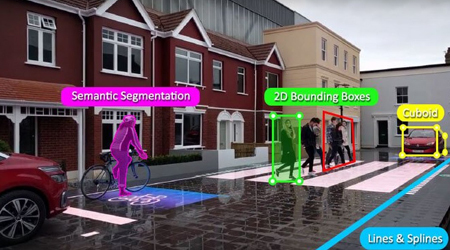
Data labeling typically assigns a category or label to data, while data annotation can add details such as object boundaries, coordinates, attributes, relationships, or timestamps. A computer vision model may require image labels or bounding boxes, a healthcare model may require precise segmentation of medical images, and an autonomous driving system may require 3D cuboids and object tracking. Understanding these approaches is important when building datasets for machine learning.
Data Annotation and Data Labeling: What Do They Mean?
Data annotation and data labeling both involve adding information to raw data so that machine learning models can learn from it. The difference mainly lies in the type and level of information added to the dataset.
Data labeling typically involves assigning categories or predefined labels to the data. For example, an image might be labeled as "automobile" or "pedestrian," and a document might be classified as "invoice" or "contract."
Data annotation can involve more detailed information about the data. Depending on the project, this may include drawing bounding boxes around objects, marking pixels for segmentation, defining 3D object dimensions, identifying timestamps in audio or video, or linking entities in text.
| Factor | Data Annotation | Data Labeling |
|---|---|---|
| Complexity and Depth | Add details such as object boundaries, attributes and other context. | Usually assigns a predefined category or label without adding much additional detail. |
| Required Expertise | May require domain knowledge, especially for specialized or technical data. | Can often be handled by generalists trained to follow clear labeling guidelines. |
| Time and Resource Investment | This typically takes more time, as each data point may require a detailed solution. | Generally takes less time when the task only requires assigning a category or label. |
| Level of Detail | Captures more information about objects, actions, relationships, or other data elements. | Focuses mainly on identifying the correct category or class. |
Both approaches provide structured reference data to AI models. The method depends on the model's purpose, the data type, and the level of detail required for the task.
What Types of Data Can Be Annotated for AI?
Different AI systems require different forms of annotated data. The choice is determined by the information the model needs to identify rather than by the data format alone.
| Data type | Annotation and labeling methods | Level of detail | Typical AI requirement | Relevant applications |
|---|---|---|---|---|
| Images | Classification, bounding boxes, polygons, semantic/instance/panoptic segmentation, keypoints, polylines | Image-level to pixel-level | Recognition, localization, boundary detection, scene understanding | Autonomous vehicles, healthcare, retail, agriculture, insurance, robotics |
| Video | Frame annotation, object tracking, temporal segmentation, activity/event labeling, trajectories | Frame-level to sequence-level | Movement, behavior, event recognition, persistent object identity | Self-driving, surveillance, robotics, sports, industrial monitoring |
| 3D / Point Clouds | 3D cuboids, point-level labels, segmentation, tracking, lane/drivable-area annotation, sensor fusion | Point-level to spatial/temporal | 3D localization, depth, geometry, navigation | Autonomous vehicles, robotics, industrial automation, agriculture |
| Text | NER, intent, sentiment, POS, document classification, relationships, entity linking | Token-level to document-level | Entity extraction, classification, semantic understanding | NLP, conversational AI, healthcare, retail, enterprise search |
| Audio | Transcription, diarization, timestamping, sound-event detection, prosody/emotion | Word/event to full-audio level | Speech recognition, speaker identification, acoustic-event recognition | Conversational AI, call analytics, accessibility, multimodal AI |
Choose the Right Annotation Method?
Choosing the right annotation or labeling method starts with understanding what the data needs to show. Before starting a project, define what the model needs to identify, predict, or understand from the data. A product-recognition model may only require image classification, while a system that needs to locate products will require bounding boxes. Applications that depend on precise shapes, movement, depth, or spatial relationships may require segmentation, tracking, or 3D annotation.
Once the objective is clear, the next step is to determine how much detail the annotations actually need to capture:
Spatial precision: Decide whether approximate object location is sufficient or whether exact boundaries are required.
Temporal requirements: Determine whether single images are sufficient or if objects, actions, or events should be tracked over time.
Semantic detail: Determine whether basic categories are sufficient or whether the model needs attributes, relationships, or contextual information.
Instance separation: Determine whether objects belonging to the same class need to be identified individually.
3D and geometric information: Identify whether depth, orientation, dimensions, or 3D position are necessary for the application.
The source data matters as well. Crowded scenes, overlapping objects, low-resolution images, medical imagery, video sequences, and LiDAR data can make simpler annotation approaches unsuitable.
Quality requirements should also be considered before production begins. A pedestrian that is not identified in an autonomous-driving dataset, for example, may have a different impact from a small variation in the boundary of a retail product. Defining accuracy requirements, review rules, and acceptance criteria helps determine how the data should be labeled or annotated and how the output should be checked.
The right method provides the required information without adding unnecessary detail. It should also be practical to apply consistently across the dataset and at the required production volume.
How Should Guidelines Be Created?
Once the method is selected, clear guidelines help different annotators to make consistent decisions across the dataset. The guidelines should explain what to label, how to label it, and how to handle cases where the correct decision is not immediately clear.
Define the taxonomy: Describe each class, its meaning, its inclusion and exclusion criteria and how to distinguish between similar categories. This provides annotators with a common reference before production begins.
Set annotation rules: Define boundaries, geometry, attributes, and other task-specific rules. For computer vision image annotation, this may include object boundaries, occlusion, truncation, and minimum size criteria. Video projects may also require rules to preserve object identity across frames.
Address difficult and domain-specific cases: Guidelines should explain how to handle blurred objects, overlapping objects, ambiguous examples, or unusual data. NLP project may require rules for entities, relationships, or multilingual representation, while medical datasets may require expert definitions and inclusion or exclusion criteria.
Define quality and escalation rules: Define expected quality levels, review requirements, and specify when an undefined case should be escalated. Pilot batches, reviewer feedback, and consensus checks can help identify unclear rules and clarify them before full-scale work.
How Does the Process Move From Guidelines to Production?
After the guidelines are set, the team applies those rules to actual production data. The process generally moves through several stages before and during production:
Project Guideline → Sample Data → Review & Calibration → Evaluation → Production
Project guidelines: Annotators refer to specific taxonomies, label definitions, annotation restrictions, tools, and rules for handling complex or ambiguous cases. These guidelines serve as the basis for annotation choice during the project.
Sample annotation: An annotator starts by working on a representative dataset. Using the project guidelines with real examples helps define how to categorize different data types and handle specific situations.
Review and calibration: Review the sample to assess any differences in interpretation and resolve issues such as occlusion, overlapping features, blurred edges, and poor data quality before detailed annotation and labeling begins.
Evaluation: The team compares annotation results with the defined quality standards to evaluate precision and uniformity and recognize ongoing problems prior to the work entering full production.
Production: Annotators use uniform annotation guidelines on a larger dataset, generating labels according to each assignment's specifications. They can also flag ambiguous cases for evaluation, and quality assessments during production help spot and fix inconsistencies.
This workflow allows the team to move from applying project requirements on representative data to handling larger datasets with a consistent approach, while providing opportunities to address new or ambiguous cases as they arise.
What Does the Data Workflow Look Like?
A scalable data workflow generally moves through:
Raw Data → Data Preparation → Taxonomy & Guidelines → Tool Setup → Labeling and Annotation → QA → Validation → Export
The process begins by removing duplicate, irrelevant or inappropriate data. Then the taxonomy and annotation rules get finalized, and configuration of the annotation environment and validation requirements are completed. Annotators create or refine the required labels, while reviewers and automated checks identify inconsistencies or structural errors.
When the results meet specific quality standards, the dataset is validated against the required schema and exported in the format needed for model development. This makes the process a structured procedure rather than an independent labeling phase.
What Formats Can Data Be Delivered In?
The data format determines how labels, coordinates, categories, and other information are organized in the final dataset. The right format depends on the type of labeling or annotation and how the data will be used during model development.
1. JSONL (JSON Lines)
JSONL stores each data record separately, making it useful for large text-based datasets. A single record can contain the input text along with its label, response, instruction, or other relevant information.
For example, a customer-support dataset might include:
Customer query: “Where can I track my order?”
Purpose: “Order tracking”
Here, the customer request is the input and the order tracking is the annotation or label assigned to that request. The label tells the AI system what type of query it is.
Another record can contain a different query and its corresponding intent. Keeping each example as a separate record makes the dataset suitable for NLP, LLM training, instruction tuning, and evaluation.
2. COCO (Common Objects in Context)
COCO is commonly used for computer-vision datasets involving object detection, segmentation, and keypoint annotation. It connects an image with information about the objects present in it and the annotations associated with those objects.
For example, an image of a road may contain:
Image: One road scene
Object 1: Car — bounding box around the car
Object 2: Pedestrian — bounding box around the pedestrian
Object 3: Traffic sign — bounding box around the sign
Here, the road scene is the input image, while the car, pedestrian, and traffic sign are the annotated objects. Their bounding boxes tell the AI system where each object is located within the image.
For segmentation projects, the format can also store the exact region occupied by each object rather than only its rectangular location.
3. YOLO (You Only Look Once)
YOLO commonly uses a simple annotation structure for object-detection datasets. Each object in an image is represented by its class and the position of its bounding box.
For example, an image may contain:
Image: A supermarket shelf
Object: Cereal box
Class: Product
Location: The rectangular region surrounding the cereal box
The same approach can be used for multiple objects in one image, with each object receiving its own class and location. YOLO-based training systems can then use these annotations to learn where specific objects appear in an image.
Other formats, including Pascal VOC and client-specific schemas, may also be required depending on the downstream system. Common data projects may support formats such as COCO, Pascal VOC, and YOLO.
How Should You Choose a Data Annotation and Labeling Partner
Choosing an annotation and labeling partner should involve more than comparing data volume, pricing, or turnaround time. The crucial step is to understand whether the provider can maintain the required level of accuracy as the dataset grows, handle difficult cases consistently, and deliver data in the required format. When evaluating a data labeling service, it is also important to look beyond the initial output and understand how quality is maintained throughout production.
A useful way to evaluate this is to review the provider’s previous project experience, quality process, workforce, security practices, technical capabilities, and communication approach. A representative pilot dataset can make this assessment more practical by showing how the team handles real project requirements before larger-scale production begins. The following areas provide a practical framework for evaluating a data annotation and labeling partner:
| Area | What to assess | Why it is important |
|---|---|---|
| Domain expertise | Experience with the specific data type, annotation or labeling method, and industry. Check whether the team has handled similar datasets and difficult cases. | Familiarity with the subject matter can reduce interpretation errors and shorten the time needed to establish project guidelines. |
| Quality control | Review stages, calibration process, QA sampling, quality metrics, disagreement handling, and escalation procedures. | Quality should be measured throughout production rather than checked only after the dataset is complete. |
| Security and data handling | Access controls, confidentiality practices, secure data transfer, storage procedures, and applicable privacy or compliance requirements. | Sensitive datasets require controlled access and clear processes for protecting data throughout the project. |
| Technology and tools | Automation features, AI-assisted labeling, validation tools, and support for different annotation and labeling methods. | Suitable tools can improve productivity while still allowing human review where accuracy is critical. |
| Scalability | Ability to increase or reduce annotation capacity, manage larger datasets, and maintain quality as project requirements change. | Production requirements can change over time, so capacity should be able to adapt without disrupting the workflow. |
| Data formats | Support for required schemas, metadata structures, file formats, and custom export requirements. | Correct labeled or annotated data still needs to be delivered in a structure that fits its intended use. |
| Project management | Communication process, progress reporting, issue tracking, turnaround for queries, and responsibility for resolving disagreements. | Clear coordination helps prevent unresolved questions from becoming repeated inconsistencies across the dataset. |
| Specialized capabilities | Experience with 3D and LiDAR, medical imagery, NLP, video, audio, multimodal data, or other task-specific requirements. | Specialized projects may require different tools, expertise, quality criteria, and workflows than standard image or text tasks. |
This small pilot can provide a practical view of how an annotation and labeling partner handles the project requirements, from accuracy and difficult cases to quality control, communication and final data delivery.
Why Anolytics for AI Data Annotation and Labeling
Data annotation and labeling connect raw data with the information a system needs to identify, classify or understand. The appropriate method depends on the task, the required level of detail, the characteristics of the source data, and the consequences of errors.
Therefore, a robust process starts with clear goals, followed by defined guidelines, quality checks, validation, and delivery in a usable format. When these elements work together, the resulting dataset is a consistent representation of the patterns that the AI system needs to understand.
Anolytics brings experience across different data types, data annotation and data labeling methods, and industry requirements, supporting projects ranging from computer vision and data annotation for robotics to text, video, and 3D data. We combine trained annotation teams, defined quality processes, and project-specific workflows to produce consistent datasets aligned with application requirements.
please contact our expert.
Talk to an Expert →
You might be interested
- Data Annotation 07 Jun, 2019
Why Human Annotated Datasets is Important for Machine Learning?
Developing an AI model through machine learning is not possible without huge volume of data like training data, testing

- Data Annotation 02 Aug, 2019
Five Reasons to Outsource Your Data Annotation Project
Artificial Intelligence (AI) and Machine Learning (ML) development is mainly rely on training data sets, that helps the

- Data Annotation 30 Oct, 2019
How To Label Data For Semantic Segmentation Deep Learning Models?
Labeling the data for computer vision is challenging, as there are multiple types of techniques used to train the algori