Training Data That Drives Autonomy: Computer Vision Datasets for AVs
 By Anolytics | 23 July, 2026 in Data Annotation | 5 mins read

Have you ever stopped to think about the fact that machines are processing color, depth, and light in a fraction of a second? The integration of computer vision and artificial intelligence brings this ability to machines. To that end, AI computer vision datasets are the primary input that machines need to interpret, analyze, and respond to visual information in ways similar to human perception.
Fine-grained labels captured in CV datasets enable advanced AI systems, making them more intuitive and impactful. The transformative technology, which includes facial recognition that identifies a person, OCR that reads text embedded in images, and pose estimation that understands how a body is positioned, stems from visual understanding.
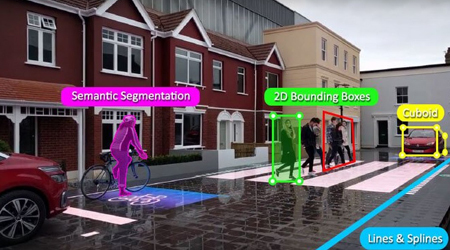
All three, as subsets of computer vision datasets, contribute differently to autonomous vehicle (AV) development. Rather than explaining the FR, bounding box, semantic segmentation, and other annotation methods, today, we are going to explore the importance of quality (in terms of contexts), diversity (beyond object detection), and accuracy (to resemble inputs from the real world) of training data directly, determining how well the system performs when it encounters real road situations.
In the following sections, we provide insights into how Anolytics machine vision datasets are well-suited for training self-driving cars to detect unexpected on-road obstacles and identify never-seen-before objects.
How Computer Vision Datasets Power AI Navigation Systems
Given computer vision’s role as the cornerstone of self-driving vehicles, it is critical to understand what context-aware AI datasets offer. This is because they rely on image recognition datasets, which only tell about what is present in a picture, whereas computer vision datasets are broader and cover a much wider range of visual understanding tasks, training machines to understand what is happening.
Teaching AVs to Respond, the Human Way
The original intent of the computer vision datasets was to replicate the awareness and situational understanding of human vision on the road. For humans, vision is a basic sensory signal that detects obstacles on the road. They don’t look at objects in isolation and understand things based on where they are, what surrounds them, and what is happening around them.
Human drivers constantly interpret road situations using perception, judgment, and context. Depending on what they see, they make different decisions:
- Stop the car when the obstacle creates immediate danger or blocks the path completely, for example, a pedestrian crossing suddenly, a fallen tree, or stalled traffic ahead.
- Take a side pass around the obstacle on wider roads or multi-lane roads, avoiding the objects, and the surrounding road conditions are safe — such as moving around a parked vehicle, debris, or a pothole after checking nearby traffic and available space.
- Slow down, reroute, or change lanes when the obstacle disrupts normal traffic flow but does not require a complete stop.
- Detect obstacles such as stalled vehicles, debris, or pedestrians,
- Recognize road boundaries for safe navigation, where the road ends, and the sidewalk begins,
- Estimate distances between surrounding objects and vehicles,
- Understand traffic conditions, including congestion, signals, and movement patterns,
- And, interpret the overall driving environment to make safer navigation decisions.
Besides the above data points, other sensing technologies are annotated to best ascertain the overall navigational situation. The development of self-driving cars also requires LiDAR sensors to capture 3D depth and distance measurements, radar systems to detect object speed and motion, thermal cameras to identify heat signatures, and infrared cameras to improve visibility in low-light or nighttime conditions.
On demand, vendors can also provide RGB roadside infrastructure datasets as the project scales up in the form of video clips, image frames, bounding box annotations, semantic segmentation labels, lane annotations, vehicle tracking IDs, pedestrian detection labels, OCR annotations for license plates, and traffic light state labels.
Initially, AI-powered navigation in self-driving cars was for avoiding obstacles, which shifted to other essential areas such as:
How Anolytics Datasets Go Beyond Object Recognition
Modern autonomous driving systems do far more than simply identify cars, pedestrians, or traffic signs. Advanced computer vision datasets are now designed to help AI systems interpret behavior, understand context, and anticipate what could happen next on the road.
We live in a world where AI is taking over almost every field, and innovation remains central to this, necessitating scalable datasets. Providers like Anolytics exist because this work demands discipline, domain expertise, and scale that most organizations can't build in-house.
1. Reading Intent from Other Drivers
Human drivers constantly predict the behavior of others without consciously thinking about it. For example:
- Understanding how to drive appropriately to avoid accidents
- Reading lane marking may indicate an upcoming lane change.
- adhering to the traffic rules and regulations
- Repeated braking in traffic may suggest congestion ahead.
- A driver inching forward at an intersection may be preparing to merge aggressively.
Inculcating responsible driving techniques in a machine means training on the above factors. Upon this, computer vision algorithms learn patterns, whether it be a sequence of images or video data. At a minute operational level, the data annotators tag:
- wheel direction,
- vehicle speed changes,
- lane positioning,
- indicator lights,
- spacing between vehicles,
- and movement trajectories.
Along with the observation, human annotators also describe the scene and what responses would be ideal to take, like when analyzing traffic lights using object detection and classification. This helps the navigation system prepare early responses, such as slowing down or adjusting distance with nearby vehicles, rather than reacting at the last second.
2. Understanding Road Conditions in Real Time
Road environments constantly change. A road that appears safe in one second may become hazardous moments later due to weather, lighting, construction activity, or traffic flow.
Computer vision datasets train models to interpret:
- wet or slippery roads,
- potholes,
- faded lane markings,
- low-visibility environments,
- construction zones,
- shadows,
- reflections,
- and unexpected debris.
For instance, human drivers instinctively slow down during heavy rain because visibility decreases and braking distances increase. Similarly, AI-powered perception systems analyze visual cues from cameras alongside depth and motion data to recognize changing road conditions in real time.
At the algorithmic level, the system performs continuous:
- semantic segmentation of the roadway,
- texture analysis,
- lane confidence estimation,
- obstacle localization,
- and scene-context interpretation.
This allows the vehicle to adapt driving behavior dynamically instead of relying on static road assumptions.
3. Inferring What Might Happen Next
One of the most advanced capabilities in autonomous driving is predictive perception — understanding not only what is happening now, but what is likely to happen next.
For example:
- A pedestrian standing near a crosswalk while looking toward traffic may suddenly step onto the road.
- A cyclist wobbling near the curb may drift into the driving lane.
- A ball rolling across the street may indicate that a child could follow behind it.
Humans naturally infer these possibilities through contextual awareness and past experience. Computer vision datasets now aim to train AI systems with similar predictive understanding by exposing models to complex real-world driving scenarios and sequential event patterns.
At a granular level, computer vision algorithms function continuously by:
- analyzing motion patterns across video frames,
- estimating object trajectories,
- monitoring behavioral anomalies,
- mapping spatial relationships,
- and assigning probability scores to possible future actions.
This enables the system to make safer decisions earlier — slowing down, increasing caution, or rerouting before a dangerous event fully unfolds.
In essence, modern computer vision datasets are no longer just teaching machines to identify objects. They are teaching AI systems to interpret movement, context, behavior, and environmental uncertainty in ways that increasingly resemble human situational awareness.
Conclusion
At the heart of every reliable computer vision system is data that has been labeled with precision and intent. Before you evaluate a model on its accuracy scores, ask where the real usage of AI computer vision datasets is applied. A traffic sign isn't just a traffic sign — it's a sign type, a visibility status, a road context.
If your AI initiative depends on accurate scene understanding, object recognition, or real-time visual intelligence, high-quality computer vision datasets are the foundation of reliable model performance.
Connect with Anolytics to access customized computer vision datasets designed for scalable, accurate, production-ready AI development.
please contact our expert.
Talk to an Expert →
You might be interested
- Data Annotation 07 Jun, 2019
Why Human Annotated Datasets is Important for Machine Learning?
Developing an AI model through machine learning is not possible without huge volume of data like training data, testing

- Data Annotation 02 Aug, 2019
Five Reasons to Outsource Your Data Annotation Project
Artificial Intelligence (AI) and Machine Learning (ML) development is mainly rely on training data sets, that helps the

- Data Annotation 30 Oct, 2019
How To Label Data For Semantic Segmentation Deep Learning Models?
Labeling the data for computer vision is challenging, as there are multiple types of techniques used to train the algori