Top 10 3D Cuboid Annotation Companies In 2026
 By Anolytics | 29 December, 2025 in Data Annotation | 4 mins read

In recent years, three-dimensional object identification has become fundamental to autonomous vehicles (AVs), Robotics, and drone systems. Core tasks, such as obstacle avoidance, path planning, object tracking, and scene reconstruction, rely on a clear understanding of spatial environments.
Although widely used in AVs and aerial systems, cuboid-based labeling is equally vital across manufacturing, construction, retail automation, and augmented reality—domains where precise spatial awareness is necessary for dependable machine perception.
As simplified geometric representations of real-world objects, 3D cuboid annotations encode key spatial attributes in a structured 3D format. This representation is in the form of object position, orientation, width, height, and depth, allowing depth estimation models to align visual, LiDAR, or stereo sensor data.
What is a 3D cuboid annotation?
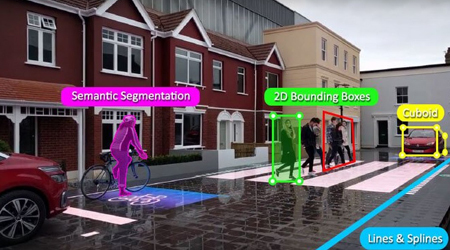
3D cuboid labeling is the process of enclosing objects within volumetric bounding boxes that represent depth in addition to height and width. 2D bounding boxes can only project object boundaries onto a flat plane, whereas 3D cuboid annotations capture the full physical volume the object occupies.
Additional information 3D cuboid labeling provides beyond simple object detection is the following:
- Precise localization → The exact 3D position of the object in the x, y, z coordinates.
- Yaw angle → The orientation or rotation of the object around the vertical axis (e.g., which direction a car is facing).
- Object footprint → The object’s physical base dimensions on the ground (its width and length).
- Distance from the sensor → How far the object is from the camera or LiDAR device.
Essential Steps in 3D Cuboid Annotation
The process of 3D cuboid annotation involves:
- Defining the boundaries of an object: In this first step, annotators draw cuboids around objects in images or video frames.
- Capturing spatial data: Each cuboid-shaped box is labeled with parameters such as length, width, height, depth, and rotation.
- Metatags for context: Additional details, such as object type and classification, provide context and are associated with metadata.
- Quality Validation: Annotated datasets are reviewed for accuracy and consistency in the training data.
How 3D Cuboid Annotation Power Depth Estimation Models
The model uses consistent ground-truth geometry to infer distance and spatial relationships within complex environments. Cuboid annotation enables models to learn how depth changes between different objects and environments by providing them with standard 3D bounding structures. The fusion of multi-sensor data allows algorithms to reconcile discrepancies between camera images and point cloud information. This combination makes depth predictions more accurate, especially in dynamic, busy, or changing scenes.
3D cuboid annotation facilitates the development of depth estimation systems that can scale and operate in real-time, which is crucial for the safe navigation of autonomous vehicles and drones.
Also Read: Why Autonomous Vehicles Can't Go Far Without 3D Point Cloud Annotation?
Best Companies Offering High-Quality 3D Cuboid Annotation Services
1. Anolytics
Anolytics offers expert 3D point-cloud annotation services to address the limitation of 2D bounding box annotation. They have secure on-premise labeling for sensitive data related to LiDAR, radar, and photogrammetry, with a focus on accurately labeling objects ranging from small to large, including pedestrians, vehicles, road infrastructure, and machinery, across both indoor and outdoor environments. Their quality assurance pipeline is designed for AV, robotics, and geospatial projects that require millimeter-level accuracy.
Key differentiator
- Hybrid workforce that balances in-house experts with a vast network of talented subject-matter experts
- Global delivery centers with GDPR and HIPAA-aligned controls
- Formats: KITTI, COCO-3D, JSON, XML, custom sensor fusion formats
- Integration is available for LiDAR, radar, and stereo cameras.
2. Cogito Tech
Cogito Tech offers top-notch 3D cuboid and point-cloud labeling services to help perception models interpret objects and their spatial properties. Their staff of professional annotators and domain specialists can assist with a range of applications, including self-driving cars, industrial robots, drone-based mapping, and digital twins. Their 3D cuboid labeling services are crucial for finding objects and modeling environments. They help businesses with smart infrastructure, autonomous navigation, industrial safety systems, and geospatial analytics.
3. Aya Data
Aya Data provides 3D cuboid annotated data with particular strength in medical imaging, AVs, defense, construction analytics, agriculture, and retail use cases. It is known for combining data science expertise with annotation, helping customers develop robust perception models, where 3D object localization is essential.
4. Damco Group
Damco's 3D point-cloud and LiDAR annotation services are scalable, offering 3D cuboid annotation, semantic segmentation, and point-level labeling services. Because they are present globally, they can manage enterprise-scale data pipelines, particularly for automobile OEMs, GIS businesses, and robotics manufacturers. Damco focuses on standardized annotation techniques and quality management systems that ISO has verified.
5. Wisepl
Wisepl enhances raw data by adding 3D cuboid labels, using skilled 3D annotators who are experienced with LiDAR and visual datasets. In retail AI projects, they assist AR project managers in curating virtual fitting rooms powered by 3D cuboid training data. For autonomous vehicles, they annotate cars, buses, pedestrians, and obstacles with 3D geometry. The geospatial mapping of terrain features and infrastructure requires a 3D representation, where cuboids help to annotate objects more effectively, and Wisepl delivers the accurate training data for this purpose.
6. HabileData
The company offers detailed 3D LiDAR point cloud annotation for machine learning applications in autonomous vehicles, robotics, and smart city mapping projects. The company’s strength lies in handling large, multi-sensor datasets and ensuring accurate annotations even in dense or noisy point-cloud environments.
7. Outforz
Outforz 3D annotation services have 3D cuboid labeling, semantic segmentation, and instance segmentation across robotics, environmental mapping, and industrial applications. Their focus on non-traditional and emerging use cases, such as mining, agricultural automation, and AR/VR spatial modeling, makes them a versatile partner for experimental or R&D-heavy projects.
8. Suntec.ai
Suntec.ai helps with detailed 3D sensor-fusion annotation by merging LiDAR, camera, and radar data to produce exact 3D shapes and boxes. They create bespoke workflows, specialized quality control systems tailored to a specific field, and teams that can scale to handle large AV projects. They work in fields such as self-driving cars, warehouse automation, smart mobility, and geospatial surveying.
Conclusion
Modern object identification algorithms rely on 3D cuboid labeling for training AI systems to deliver exceptional accuracy for complex computer vision tasks. For autonomous vehicles, drones, and robotics, accurate cuboid annotation adds depth, orientation, and spatial information that influence decision-making. Well-known datasets built on high-quality 3D cuboid annotation have consistently enabled researchers to evaluate performance, compare results, and drive breakthroughs across the industry.
However, with the growing number of data labeling vendors in the market, selecting the right partner has become increasingly challenging for startups, researchers, and enterprises. This is where reliable companies such as Anolytics stand out. Our human-in-the-loop quality checks, domain-trained annotators, and scalable infrastructure make us a preferred partner for teams looking to build robust, future-ready AI systems.
If you require additional assistance, choose Anolytics, and we can arrange a discussion to address your needs.
please contact our expert.
Talk to an Expert →
You might be interested
- Data Annotation 07 Jun, 2019
Why Human Annotated Datasets is Important for Machine Learning?
Developing an AI model through machine learning is not possible without huge volume of data like training data, testing

- Data Annotation 02 Aug, 2019
Five Reasons to Outsource Your Data Annotation Project
Artificial Intelligence (AI) and Machine Learning (ML) development is mainly rely on training data sets, that helps the

- Data Annotation 30 Oct, 2019
How To Label Data For Semantic Segmentation Deep Learning Models?
Labeling the data for computer vision is challenging, as there are multiple types of techniques used to train the algori