Video Annotation Services for Machine Learning: Techniques and Applications
 By Anolytics | 04 November, 2026 in Video Annotation | 7 mins read

The global video annotation services market is valued at approximately USD 3.26 billion in 2026 and is projected to grow to USD 18.67 billion by 2035. This represents a 21.4% CAGR over the 2026–2035 forecast period, reflecting the growing demand for high-quality annotated video data for AI and machine learning applications.
Video has become an important source of training data for machine learning systems. Unlike static images, video captures people, objects, environments, and actions as they change over time. This makes video useful for applications such as robotics, autonomous systems, surveillance, sports analysis, retail analytics, healthcare, and industrial monitoring.
However, converting raw video into training data needs more than labeling individual frames. Machine learning models often need to perceive how an object moves, when an action starts and ends, how a scene changes over time, and how objects interact.
What is Video Annotation for Machine Learning?
Video annotation adds structured labels to video data to make it comprehensive for machine learning models. It helps models learn to recognize objects, actions, movements, events, and other visual patterns.
Depending on the use case, video annotators may identify objects in individual frames, track the same object across frames, mark specific events or actions, segment regions of interest, or label changes over a specific period of time.
For instance, in a traffic video, annotation allows tracking pedestrians, cars, bicycles, and traffic signs. The same vehicle can then be identified across consecutive frames to help a model learn its movement. This temporal dimension makes video annotation different from conventional image annotation. An image details a single moment, while video provides a sequence of connected moments.
Why Video Annotation Solutions are Important for Machine Learning?
Machine learning models learn from training data. For video-based models, consider a video of a person entering a room. A single frame can show the person, the doorway, and surrounding objects, but it does not describe the action fully. A sequence of frames can show the person’s movement from outside the room to inside. Annotating that sequence as an event gives the model information about the action and its temporal boundaries.
High-quality video annotation can therefore support models that need to track objects, identify movement, recognize activities, identify events, and understand interactions within a scene.
Label quality also affects downstream model performance. Several factors, such as inaccurate object identities, inaccurate boundaries, missing frames, or incorrect event timestamps, can introduce noise into training datasets.
Core Video Annotation Techniques
Video annotation can involve several techniques depending on what the machine learning model needs to learn.
Bounding Box Annotation
Bounding boxes mark objects within video frames. An annotator draws a rectangular box around an object and assigns it a class label, such as car, person, animal, or product.
In video workflows, the same object may need labeling across different frames. As the object moves, it is important to maintain consistent boundaries for training detection and tracking models.
Object Tracking
Object tracking extends annotation across a sequence of frames. Instead of treating each frame independently, annotators maintain an object's identity as it moves through the video.
For example, a vehicle appearing in frame 10 and continuing through frame 50 should retain the same object identity unless the annotation guidelines specify otherwise.
Tracking becomes more challenging when objects overlap, leave the camera's field of view, reappear later, or become partially hidden.
Polygon and Segmentation Annotation
Some applications require more precise object boundaries than rectangular bounding boxes can provide. Polygon annotation can follow an object's shape, while segmentation assigns labels to pixels belonging to specific objects or regions. This is useful when object shape, boundaries, or precise regions matter to the machine learning task.
Keypoint and Pose Annotation
Keypoints identify specific locations on an object or human body. In human activity applications, these may represent joints such as shoulders, elbows, wrists, hips, knees, and ankles.
Pose-based annotation can help models learn movement, posture, gestures, and other forms of human activity.
Action and Event Annotation
Video can also be labeled according to actions or events rather than only visible objects.
For example, a dataset may contain labels for walking, running, falling, picking up an object, opening a door, or other defined activities. These labels can be associated with specific time intervals so that models can learn when an event begins and ends.
Temporal Annotation
Temporal annotation identifies important points or intervals within a video. Video annotators may mark the beginning and end of an event, identify changes in activity, or divide a continuous recording into meaningful segments.
This is particularly important for applications involving activity recognition, event detection, and behavior analysis.
Video Annotation vs. Image Annotation
The fundamental difference between image and video annotation is temporal information.
With image annotation, each image is generally treated as an individual observation. The focus may be on identifying objects, classifying the scene, or labeling specific regions.
Video annotation introduces continuity. An object needs to remain consistently labeled as it moves between frames. Actions need temporal boundaries. Occlusions and camera movement need to be considered across a sequence rather than within a single image.
For example, identifying a pedestrian in one image is an object detection task. Following that pedestrian across 100 frames introduces an object-tracking problem. Identifying when the pedestrian starts crossing the road adds another layer of temporal event annotation.
This combination of spatial and temporal information makes video datasets more complex to create and validate.
Video Annotation Service Workflow
A video annotation project begins with defining the machine learning objective and the annotation taxonomy. Before production starts, annotation guidelines should specify which objects, actions, events, or attributes need to be labeled and how difficult cases should be handled.
The raw video can then be processed and divided into relevant clips or frames. Depending on the project, teams may annotate every frame or use selected frames and temporal intervals.
Annotation is followed by quality review and validation. Reviewers check object boundaries, class labels, tracking continuity, event timestamps, and other project-specific requirements. Difficult cases such as occlusion, motion blur, poor lighting, and overlapping objects may require additional review.
AI-assisted tools can also help accelerate the workflow by generating preliminary labels, tracking objects across frames, or interpolating annotations between frames. Human reviewers remain important for correcting inaccurate predictions and handling ambiguous cases. The final dataset can then be formatted according to the requirements of the machine learning pipeline.
Challenges for Video Annotation Companies
Video annotation is often more demanding than image annotation because the data volume is much higher and labels must remain consistent over time.
One common challenge is occlusion. An object may become partially or completely hidden behind another object and later reappear. Annotation guidelines need to define how to maintain object identity in these situations.
Motion blur can also make object boundaries difficult to determine. Fast-moving objects may appear differently across consecutive frames, requiring careful interpretation.
Camera movement introduces another challenge. In applications involving handheld cameras, drones, vehicles, or surveillance systems, the entire scene may shift even when individual objects remain stationary.
Another issue is temporal consistency. If an object is labeled differently across consecutive frames without a meaningful reason, the resulting dataset can make it harder for tracking or action-recognition models to learn consistent patterns.
Large video volumes also create practical challenges. A long recording can contain thousands of frames, making annotation time-consuming when every frame requires manual review.
Applications of Video Annotation in Machine Learning
Video annotation services support a wide range of machine learning applications.
In autonomous vehicles, annotated video can help models detect and track vehicles, pedestrians, cyclists, road signs, and other objects while understanding their movement within the environment.
In robotics, video annotation can support object recognition, human-robot interaction, manipulation tasks, activity recognition, and scene understanding.
For retail and smart environments, annotated video can be used to develop models that recognize customer movement, interactions with products, occupancy, and defined activities.
In sports analytics, annotation can capture player movement, body position, ball trajectories, and specific actions. These labels can support systems designed for performance analysis and activity recognition.
In healthcare, video datasets may be used to analyze movement, rehabilitation activities, patient behavior, or defined clinical and caregiving scenarios, depending on the application and data requirements.
In industrial environments, annotated video can support inspection, worker activity analysis, equipment monitoring, safety-event detection, and other computer vision applications.
Steps Followed by Anolytics' Team for Video Annotation Process
Project Assessment and Requirement Analysis
It starts with a review of project requirements, annotation objectives, and expected output. The initial assessment involves materials and discussions with the client and technical experts.
Data Preparation
Anolytics team prepares raw data by organizing and processing the required video streams or frames. Data preparation includes sorting, filtering, segmenting, and preparing unstructured data such as videos.
Annotation and Labeling
According to the project’s specifications, our annotators label the required objects, events, or other visual elements. Our computer-vision offering for video annotation works with accurately annotated training data on a frame-by-frame basis.
Tracking across Frames
For applications involving moving objects, you can maintain annotations across frames to capture movement and object trajectories. Anolytics team describes an image/video annotation technique for capturing an object’s movement over time.
Quality Review and Auditing
Anolytics offers multiple stages of auditing and reviewing labeled data, along with representative-sample verification and quality review.
Validation and Error Correction
A representative sample of completed work is validated against the required quality standards. Errors or inconsistencies identified during review can be corrected before delivery.
Final Dataset Delivery
After annotation and quality checks are completed, the validated dataset is prepared for use in machine learning and computer vision workflows. Anolytics video annotation service offers training data for machine learning, computer vision systems, and AI applications.
AI-Assisted Video Annotation
The scale of video data makes fully manual annotation difficult for many machine learning projects. AI-assisted annotation can help reduce repetitive work by generating preliminary labels that human annotators can review and correct.
For example, an annotation system may detect an object in an initial frame and propagate the label across subsequent frames. Models can also generate preliminary segmentation masks or identify potential events.
However, automated predictions are not always accurate. Occlusion, unusual object appearances, poor image quality, camera movement, and uncommon scenarios can result in incorrect labels.
A human-in-the-loop approach can therefore combine automated pre-labeling with human review. This allows teams to use automation for repetitive tasks while retaining human judgment for edge cases and quality control.
Quality Assurance in Video Annotation
Quality assurance needs to consider both individual labels and their consistency across time.
Review processes can examine whether objects have been assigned the correct classes, whether boundaries are accurate, whether object identities remain consistent, and whether event timestamps follow the annotation guidelines.
For large datasets, quality checks can include sample-based audits, independent reviews, disagreement analysis, and targeted review of difficult or ambiguous video segments.
Clear annotation guidelines are equally important. They should define how teams handle occlusion, object entry and exit, partial visibility, motion blur, overlapping objects, ambiguous actions, and other project-specific edge cases.
Building a High-Quality Video Dataset for Machine Learning
A reliable video dataset starts with a clearly defined machine learning objective. The video annotation taxonomy should reflect what the model needs to learn rather than attempting to label every visible element in the video.
Data diversity is also important. Training videos should represent the range of conditions that the model is expected to encounter, including different environments, viewpoints, lighting conditions, object appearances, and movement patterns where relevant to the use case.
Annotation guidelines should then translate these requirements into clear instructions for the annotation team. Consistent labeling rules, quality review, and validation help reduce variations between annotators and improve dataset reliability.
For complex video projects, the annotation workflow may combine automated assistance, human annotation, expert review, and quality assurance to create a dataset that is both scalable and consistent.
Conclusion
Video annotation services for machine learning go beyond labeling individual frames. It combines spatial labeling with temporal information to help models understand objects, movement, actions, and events as they unfold.
From object detection and tracking to activity recognition, robotics, autonomous systems, healthcare, and industrial applications, high-quality annotated video can provide the training data needed for machine learning systems to interpret real-world visual environments. The key is not simply to label more frames, but to create consistent, context-rich annotations that represent how visual information changes over time.
please contact our expert.
Talk to an Expert →
You might be interested

- Video Annotation 28 Jul, 2021
Video Annotation in Machine Learning and AI
Video annotation, like image annotation, aids in the recognition of objects by modern machines using computer vision. De

- Video Annotation 01 Nov, 2025
Leading Video Annotation Companies Revolutionizing AI in 2026
Training computer vision models to interpret video content requires more than labeling static frames; it demands attenti
- Video Annotation 10 Jun, 2026
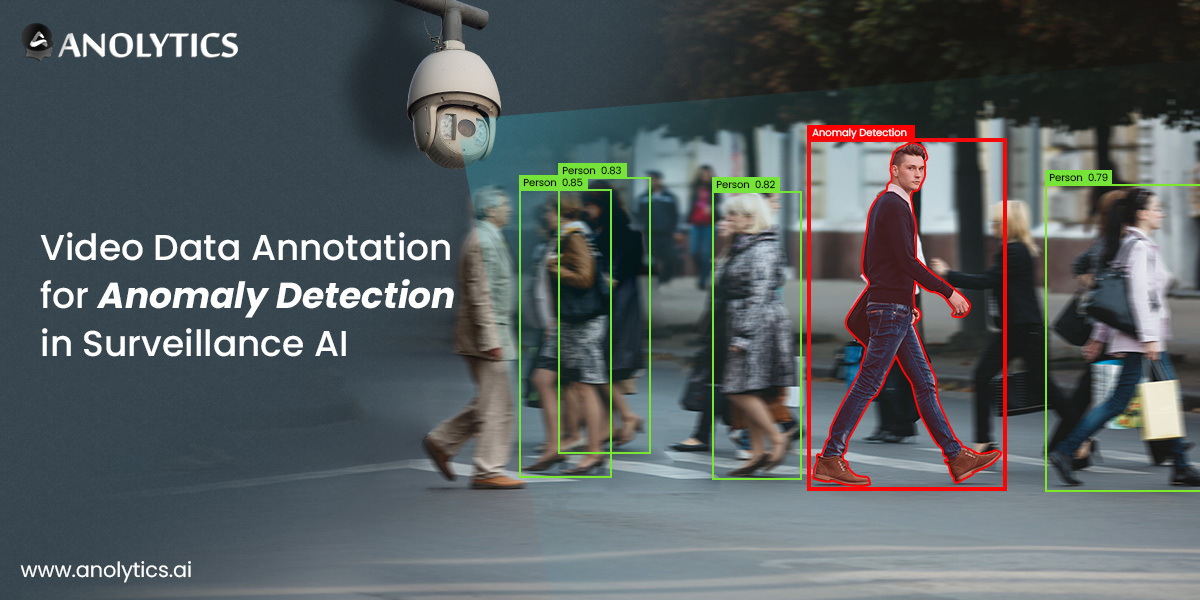
Video Data Annotation for Anomaly Detection in Surveillance AI
An artificial intelligence system is trained on a range of data formats—from text and audio to images and video—each