Why Image Data Annotation Is Essential for Intelligent Robotic Vision
 By Anolytics | 09 February, 2026 in Data Annotation | 6 mins read

The ability of robots to detect objects for sorting tasks has improved steadily. It is an essential function of a robot to not only identify an object but also grasp, rotate, and assemble it. The difference lies in the approach used for data annotation.
Object detection informs a robot about the presence of items, whereas image annotation equips robots with the ability to comprehend objects with precision and contextual relevance. Among many methods of training robots, the foundational role is that of data annotation, ranging from inventory management and predictive maintenance to sorting boxes powered by computer vision-based models, not just what to see, but how to act.
This blog delves into how data annotation services enable robotic systems to move beyond perception and achieve precision, explores prevalent image annotation techniques in robotics, and addresses the challenges of adoption, emphasizing the need for robotics AI advancements to be scrutinized by professionals.
Understanding Robots' Vision
Without image annotation, it's just pixels for machines, not intelligence.
Robotic intelligence is fundamentally constrained by the quality of its visual perception. Vision-based perception is a core sensing modality in robotics. Robots rely heavily on vision to understand scenes, on object recognition to interact with the physical world, and on spatial awareness to navigate.
One of the most important sensors benefiting robots is the image sensor, which provides visual information about the environment. Developers thus utilize image sensors and image processing capabilities in the design, which can be integrated into robot systems as any other component.
The vision-related components of a robot system require training on diverse visual inputs, including:
- Camera module, to simulate the eye of a robot
- RGB images for object detection and classification
- Depth images to estimate distance, shape, and orientation
- Stereo images for 3D perception and scene reconstruction
- Thermal images for low-visibility or safety-critical environments
- Simulated image training to speed up training when in unusual situations
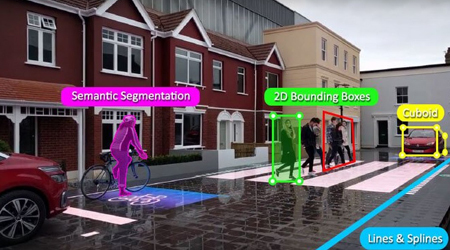
Each image type requires precise annotation techniques such as bounding boxes, semantic segmentation, instance segmentation, and keypoint labeling. Therefore, it is crucial to address the developer’s demand for flexible data annotation solutions when developing new robot systems, both industrial and service-oriented.
Common Image Annotation Techniques and Their Application in Robotics
Advanced robots can perceive their surroundings, process images, and perform more vision-based tasks due to computer vision technology- a fundamental aspect of robotics, enabling robots to perceive and understand their environment through models trained on accurately annotated image datasets. Therefore, in this section, we will explore some of the key computer vision techniques used in robotics.
Let us explore the common methods used in the development of robotics AI.
1. Image Segmentation and Feature Extraction
Image segmentation breaks an image into its parts. Many computer vision applications depend on this step to help the robot understand the scene. However, feature extraction retrieves vital information from an image, such as edges, corners, and textures. This information can help machines recognize and analyze an image.
Robots use image segmentation to detect and separate certain regions. This simplifies navigation and object recognition. Image segmentation lets a robot discover and use objects for 3D reconstruction and localization, which are crucial for navigation.
2. Image enhancement
Filtering, edge detection, and segmentation are examples of visual processing techniques that can be used to separate objects from their backgrounds. Sometimes, annotators have to enhance visual qualities by adjusting brightness, contrast, and color balance, and by reducing blur, all of which improve the image's visual quality. The capacity of a robot to distinguish objects included in an image can be improved by image enhancement methods.
3. Image restoration
It is used to repair or improve the quality of a degraded image. These techniques help with scene understanding, which involves interpreting a scene's context, including the relationships among objects and the overall layout of the environment. This process can be achieved using techniques such as semantic segmentation and scene graph generation.
Image restoration techniques improve the quality of degraded images, enabling a robot to more accurately interpret them. For example, removing noise from an image can make it easier for a robot to recognize objects in it.
4. 3D Reconstruction and Depth Estimation
It means creating a 3D scene from multiple images using stereo vision and structure-from-motion; whereas image depth estimation determines how far things are from the camera, and stereo matching and monocular depth estimation help with this.
Common 3D reconstruction and depth estimation methods are:
- Stereo vision: Comparing camera images to determine depth.
- Structure from motion: using camera movement to determine a scene's 3D geometry.
- Monocular depth estimate: a way to figure out depth using just one camera.
The choice of camera depends on the task-specific datasets required for robotic training, movements, and indoor/outdoor usage. In enabling robots with vision, from image capture to object manipulation, large volumes of data annotation strategies are undertaken.
The journey is challenging, as developers continually need high-quality training datasets to enable robots to effectively identify, understand, perceive, and respond to their environment.
Read more: The value of image annotation services for AI and machine learning
Obstacles to Overcome in Robotics AI
Despite significant advancements in robot image processing, developing them is not free from challenges. Let us discuss the obstacles and constraints that hinder progress in robotics AI applications.
1. Highly variable environmental conditions:
Robotic vision systems must work even when the light changes, objects block the view, the viewpoint alters, or background noise is high. If not, warehouse robots may struggle to locate goods in shadows, reflective surfaces, or low light when trained only in well-lit environments. Similarly, outdoor autonomous delivery trucks and agricultural robots can find weather changes, sun glare, and seasonal terrain changes as optimal, but may underperform in shadows and low-light conditions or vice versa. Data augmentation and well-annotated training datasets are needed to make image processing algorithms immune to the said volatility.
2. Limited datasets:
Large, labeled datasets for robotics applications are scarce. When training service robots, limited datasets make it difficult to validate models for real human attitudes, gestures, and interactions, hindering their ability to engage securely with people. Moreover, some open-source datasets may not be as diverse or representative and may require human oversight to avoid overfitting. While some training needs a very specific type of annotation, such as marking each pixel, labeling depth, creating 3D boxes, or noting time, without these, robots are more likely to fail in new situations or unusual cases.
3. Safety and Certification Standards
Robotic systems must follow strict safety guidelines to avoid harming people, property, and the environment. ISO 10218 (industrial robots) and ISO/TS 15066 (collaborative robotics) limit force, how far a robot may stop safely, and emergency procedures.
A human-interacting robotic arm must demonstrate that its vision system can reliably see humans and cease movement. Perception failure, often caused by insufficient or biased training data, can delay or cease certification.
4. Data Privacy and Surveillance Regulations
In public or semi-public spaces, cameras and sensors on robots collect sensitive visual data. GDPR, CCPA, and other data privacy laws restrict data collection, storage, permission, and usage. For example, a robot that is still learning how to care for the elderly might take pictures of people's faces, record their habits, or collect patient data. Even so, for real-world use cases, developers must use anonymized, legally compliant, and reliable image data for training and inference. If left unaddressed, such an error complicates long-term use; thus, outsourcing data annotation services helps maintain compliant-ready datasets useful for fine-tuning and further enhancements.
5. Industry-specific Regulatory Constraints
Different businesses have additional regulations:
- Healthcare robots must follow medical device and clinical validation criteria.
- Road safety laws, ODDs, and regional transport authorities govern delivery robots and self-driving automobiles.
- Defense and security robots must comply with data-use, export, and national security restrictions.
Each region requires specific datasets, domain-aware annotations, and rigorous validation, which delay development.
Why Robots for Advanced Capabilities Require Professional Solutions
Data annotation services in robotics tend to address the challenges discussed above. Let us find out how a professional does it.
1. Environment- and situation-aware data labeling
Robotics applications require specialized task annotations. Unlike generic datasets, which will only lead to generalization in robots, task-specific annotations are necessary. To execute this, professional annotators add comments or metadata like low light, occlusion, motion blur, crowded backgrounds, and other perspectives. These labelings help visualize better for real-life tasks; for example, warehouse robots perform better with datasets that mark overlapping bundles, glossy surfaces, and partially visible objects.
2. Support for real-time perception models
Anolytics' data annotation services for robotics focus on key elements, regions of interest, and temporal continuity in images and video. It is further optimized for real-time processing tasks. The service allows robotics developers to train them for quick responses without compromising accuracy, which is crucial for fast-paced applications such as avoiding barriers and collisions.
3. Access to large, scalable, and diverse datasets
Anolytics addresses data set limitations by offering adaptable teams to clients. Whether it's robotic arms in manufacturing or drones surveying pipelines, our expertly annotated data enhances path-planning algorithms, enabling robots to foresee obstacles and determine the best routes.
4. Advanced annotation types required for robotics
Robotics applications require advanced annotations beyond basic bounding boxes, such as:
- Pixel-level semantic and instance segmentation
- 3D bounding boxes and point cloud labeling
- Depth, keypoint, and pose annotations
- Temporal annotations for video and motion tracking
Expert teams possess the necessary tools and knowledge to produce these high-precision labels efficiently, paving the way for the next phase of model development.
5. Ethically selected, compliance-ready datasets
Compliance-related standards in the annotation process protect data privacy, anonymize data, and verify ethical sourcing. Regulatory rules regarding sensitive visual elements include capturing faces without permission or taking images of license plates or IDs, which constitute identity theft when not blurred or removed. This is where data anonymization is very important and must be used for public, medical, and workplace robots. At Anolytics, our professional annotation services integrate human-in-the-loop workflows to validate edge cases, correct model errors, and continuously improve dataset quality.
Conclusion
Image annotation is an essential part of robotics because it enables robots to observe and comprehend their operating environment. In addition, developments in robotics, driven by deep learning and computer vision, have substantially improved their capabilities, and we can anticipate that future innovations will continue in this field.
As interest in robotics AI continues to develop, we may anticipate the emergence of new methods and technologies, and the demand for high-quality image data will increase to train machines to perform increasingly complex tasks.
Anolytics consistently provides comprehensive support for facilitating advanced perception and control training for robots, ensuring they are equipped with the necessary skills to navigate complex environments and perform intricate tasks effectively.
please contact our expert.
Talk to an Expert →
You might be interested
- Data Annotation 07 Jun, 2019
Why Human Annotated Datasets is Important for Machine Learning?
Developing an AI model through machine learning is not possible without huge volume of data like training data, testing

- Data Annotation 02 Aug, 2019
Five Reasons to Outsource Your Data Annotation Project
Artificial Intelligence (AI) and Machine Learning (ML) development is mainly rely on training data sets, that helps the

- Data Annotation 30 Oct, 2019
How To Label Data For Semantic Segmentation Deep Learning Models?
Labeling the data for computer vision is challenging, as there are multiple types of techniques used to train the algori